Best Employee Engagement Platforms for HR Teams in 2026
Employee engagement platforms help HR teams understand how employees feel about their work, managers, teams, and organization. Depending on the platform, employee engagement software can support surveys, pulse feedback, employee listening, recognition, analytics, action planning, employee experience, and manager feedback.
In 2026, HR teams are increasingly looking beyond annual employee surveys. They may need continuous feedback, employee sentiment analysis, recognition programs, manager insights, and tools that help turn feedback into action.
This guide covers 10 employee engagement platforms that address different HR requirements, from enterprise employee experience and people analytics to employee surveys, recognition, continuous feedback, and frontline workforce engagement.
Important: This is a curated informational comparison, not a ranking based on hands-on testing by HRHelpBoard. Product features, pricing, plans, integrations, and availability can change, so organizations should verify current information directly with the vendor before purchasing.
Why these platforms were selected: HRHelpBoard selected these platforms based on their relevance to employee engagement, employee feedback, recognition, employee experience, surveys, analytics, and related HR requirements.
What Is Employee Engagement Software Used For?
Employee engagement software is technology that helps organizations collect and understand employee feedback and identify areas that may influence employee engagement and workplace experience.
Depending on the product, employee engagement software can help HR teams:
- Conduct employee engagement surveys
- Run pulse surveys
- Collect employee feedback
- Measure employee sentiment
- Track engagement trends
- Analyze survey responses
- Identify engagement drivers
- Support manager action planning
- Recognize and reward employees
- Measure employee experience
- Connect feedback with performance and development
- Create reports and dashboards
The purpose of employee engagement software is not simply to collect more employee feedback. The more important goal is to help organizations understand that feedback and determine what actions may be appropriate.
Employee Engagement Platforms at a Glance
| Logo |
Platform |
Employee Surveys |
Feedback |
Recognition |
Analytics |
Primary Focus |
|
|
Qualtrics Employee Experience |
Yes |
Yes |
— |
Yes |
Enterprise employee experience |
|
|
Culture Amp |
Yes |
Yes |
— |
Yes |
Engagement and people analytics |
|
|
Lattice |
Yes |
Yes |
Yes |
Yes |
Engagement and performance |
|
|
15Five |
Yes |
Yes |
Yes |
Yes |
Continuous feedback |
|
|
Leapsome |
Yes |
Yes |
— |
Yes |
Engagement and development |
|
|
WorkTango |
Yes |
Yes |
Yes |
Yes |
Listening and recognition |
|
|
Connecteam |
Yes |
Yes |
Yes |
— |
Frontline engagement |
|
|
Empuls |
Yes |
Yes |
Yes |
Yes |
Engagement and rewards |
|
|
SurveySparrow |
Yes |
Yes |
— |
Yes |
Surveys and feedback |
|
|
Workleap Officevibe |
Yes |
Yes |
Yes |
Yes |
Pulse surveys and team feedback |
Note: This is a use-case comparison rather than an overall ranking. Feature availability can vary by plan, product version, region, and contract.
10 Employee Engagement Platforms to Consider in 2026
The platforms below offer different approaches to engagement, from employee listening and surveys to recognition, performance, analytics, and frontline workforce engagement.
Qualtrics Employee Experience
Best for: Enterprise employee listening and employee experience.
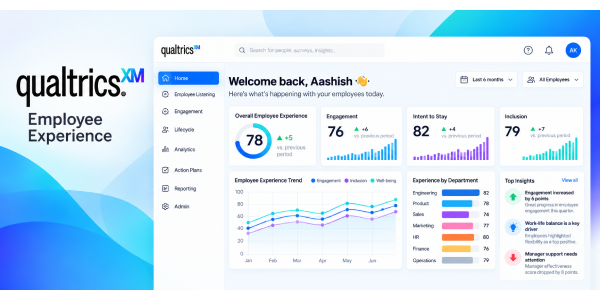
Qualtrics Employee Experience provides employee engagement and employee listening capabilities designed to help organizations capture feedback, analyze employee sentiment, identify engagement drivers, and support action planning. Qualtrics describes its employee engagement offering around continuous feedback, pulse surveys, employee listening, analytics, engagement drivers, and manager action planning.
Key Features
- Employee engagement surveys
- Pulse surveys
- Continuous employee feedback
- Employee listening
- Analytics
- Engagement-driver analysis
- Action planning
- Reporting
- AI-supported insights
| Why consider it |
What to verify |
| Qualtrics may be relevant for organizations that need employee engagement to form part of a broader employee experience and employee listening strategy. |
Check the specific Employee Experience products included in the proposal, analytics capabilities, AI functionality, integrations, implementation requirements, data privacy provisions, and support.
|
Pros
-
Comprehensive employee listening and engagement surveys.
-
Advanced analytics and customizable dashboards.
-
Supports pulse surveys and continuous feedback.
-
Helps identify engagement trends and potential improvement areas.
-
Offers capabilities for large, complex organizations.
Cons
-
Can be expensive for smaller organizations.
-
The extensive feature set may require a learning curve.
-
Employee data integration and setup may require additional effort.
-
Some dashboard visualizations and customization options may be limited.
- Pricing and available features may depend on the selected package.
Best for: Employee engagement and people analytics
Culture Amp combines employee engagement with broader employee experience, performance, development, and people analytics capabilities. Its engagement offering includes surveys, engagement insights, benchmarks, pulse surveys, AI-supported analysis, and action planning.
Key Features
- Employee engagement surveys
- Pulse surveys
- Employee feedback
- People analytics
- Benchmarking
- Action planning
- Employee development
- AI-assisted insights
- Reporting
| Why consider it |
What to verify |
| Culture Amp may be useful for HR and People teams that want employee engagement information connected with broader people analytics and development processes. |
Check which products and modules are included, benchmark availability, analytics, integrations, implementation support, service level, and total contract cost. |
Pros
-
Research-backed employee engagement surveys and templates.
-
Useful analytics for understanding employee sentiment and engagement trends.
-
Benchmarking capabilities to compare engagement results.
-
Feedback and action-planning features.
-
Generally positive user feedback on usability and survey creation.
Cons
-
Pricing may be challenging for smaller organizations.
-
Some users report limitations in reporting and customization.
-
Certain features can take time to learn.
-
HRIS integrations and employee data synchronization may require troubleshooting.
- Advanced workflows and reporting may not meet every organization's needs.
Best for:Connecting employee engagement with performance
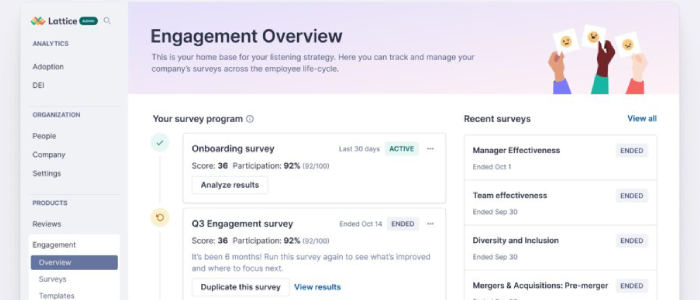
Lattice is a people-management platform that combines feedback, 1:1s, performance management, goals, analytics, employee engagement, and development. Its current Engagement offering includes pulse surveys, onboarding and exit surveys, action planning, eNPS, and AI analysis and trends.
Key Features
- Employee Feedback
- 1:1s
- Performance management
- Goals and OKRs
- Engagement surveys
- Pulse surveys
- eNPs
- Analytics
- AI supported capabilities
- Employee development
| Why consider it |
What to verify |
| Lattice may be relevant when an organization wants employee engagement to connect with performance management, goals, feedback, and employee development. |
Check which engagement functionality is included in the selected package, whether additional products are required, minimum annual commitments, integrations, implementation requirements, and total cost. |
Pros
-
Combines performance management, goal setting, and employee development.
-
Supports continuous feedback and one-on-one meetings.
-
Provides employee engagement surveys and feedback collection.
-
Helps align individual and team goals through OKR tracking.
-
Offers an intuitive interface for managing performance reviews.
Cons
-
Pricing may be challenging for smaller organizations.
-
Some users report limitations in reporting and customization.
-
The wide range of features can take time to learn.
-
Initial setup and workflow configuration may require additional effort.
- Features and capabilities may vary depending on the selected plan.
Best for:Continuous employee feedback and engagement
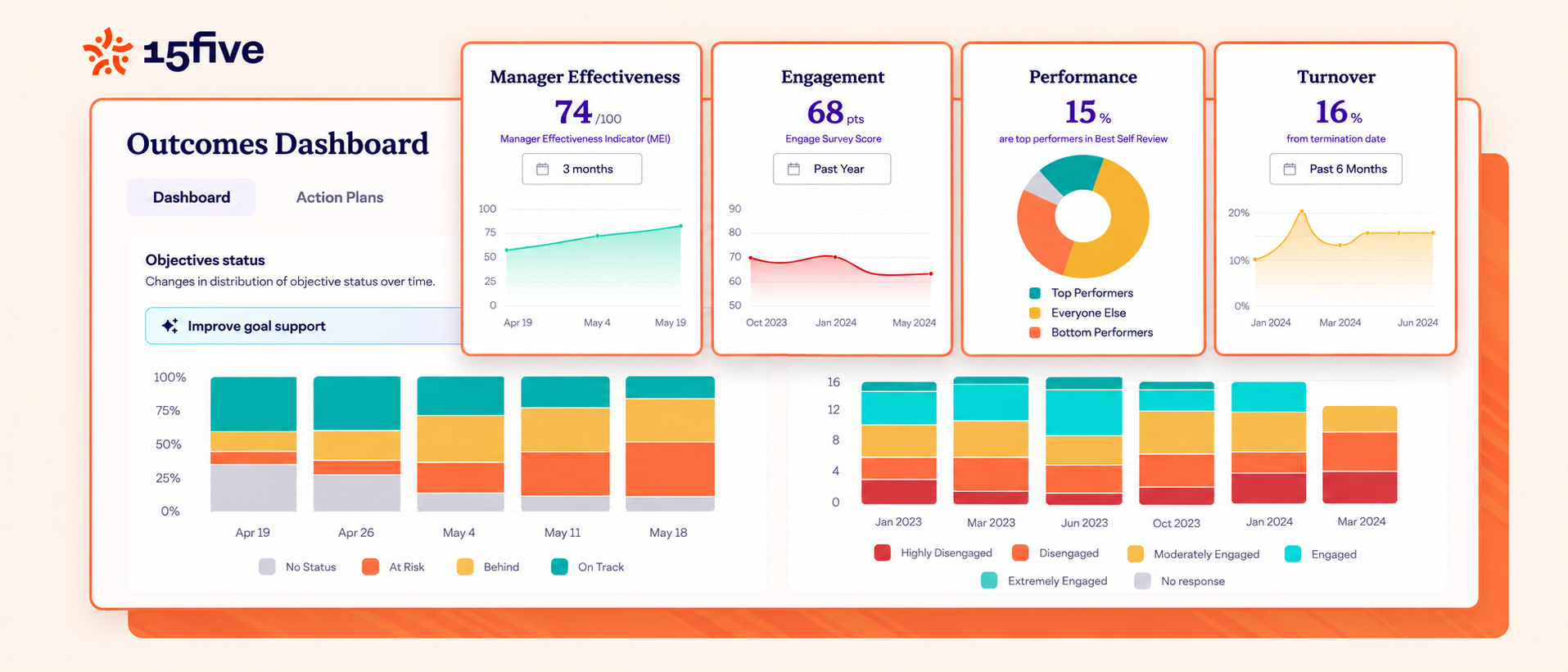
15Five focuses on employee engagement, continuous feedback, performance, and manager effectiveness. Its Engage product is designed to help organizations understand engagement drivers and determine where action may be needed. 15Five currently lists employee engagement surveys, targeted assessments, action planning, heat maps, data breakdowns, and benchmarking as part of Engage.
Key Features
- Employee engagement surveys
- Targeted assessments
- Pulse feedback
- Action planning
- Heat maps
- Data breakdowns
- Benchmarking
- eNPS
- Feedback
- Mobile access
| Why consider it |
What to verify |
| 15Five may be suitable for organizations that want to move from occasional employee surveys toward a more continuous feedback process. |
Check package limits, employee numbers, integrations, implementation, reporting capabilities, and which features require additional plans. |
Pros
-
Supports regular employee check-ins and one-on-one meetings.
-
Offers employee engagement surveys and feedback tools.
-
Helps track goals, OKRs, and performance reviews.
-
Provides peer recognition through its High Fives feature.
-
Offers useful insights into employee engagement and performance trends.
-
Generally receives positive user feedback for ease of use and performance review workflows.
Cons
-
Pricing may be challenging for smaller organizations.
-
Some users report limitations in customization and reporting.
-
Goal tracking and complex OKR management may feel inflexible.
-
Frequent check-ins and notifications may become repetitive.
-
tain advanced features are available only on higher-tier plans.
-
Initial setup and some administrative tasks may require additional effort.
Best for:Engagement, performance, learning, and development
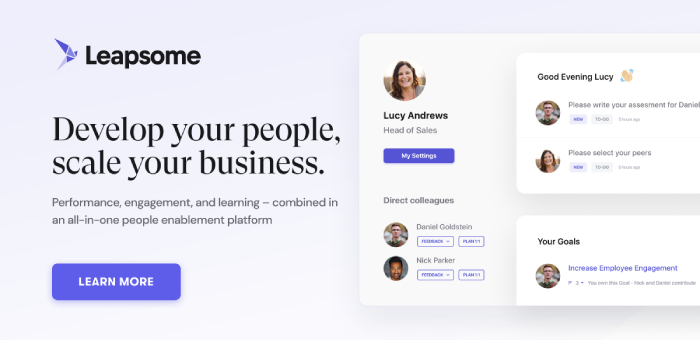
Leapsome brings employee engagement together with performance management, learning, goals, feedback, and employee development. This broader approach can be relevant for organizations that want employee engagement to connect with employee growth and development.
Key Features
- Employee feedback
- Engagement surveys
- Performance management
- Goals
- Learning
- Employee development
- Analytics
- Action planning
| Why consider it |
What to verify |
| Leapsome may be worth considering when HR teams want engagement, performance, learning, and development capabilities within a broader employee platform. |
Check the modules required for your organization, current pricing, minimum commitments, integrations, implementation, analytics, and support. |
Pros
-
Combines performance reviews, employee engagement surveys, and goal management in one platform.
-
Supports 360-degree feedback and continuous performance conversations.
-
Offers learning paths and individual development plans.
-
Provides OKR tracking to align employee and organizational goals.
-
Features analytics to help HR teams understand employee feedback and performance trends.
-
Generally receives positive user feedback for its interface and customer support.
Cons
-
Pricing can become expensive when purchasing multiple modules.
-
Initial setup of performance review templates and workflows may take time.
-
Some users report a learning curve when navigating its features.
-
Customization options for goals and automated messaging may be limited for some needs.
-
Some users report navigation, reporting, or data-export limitations.
-
Notifications and calendar integrations may require adjustments.
Best for:Employee listening, recognition, and rewards
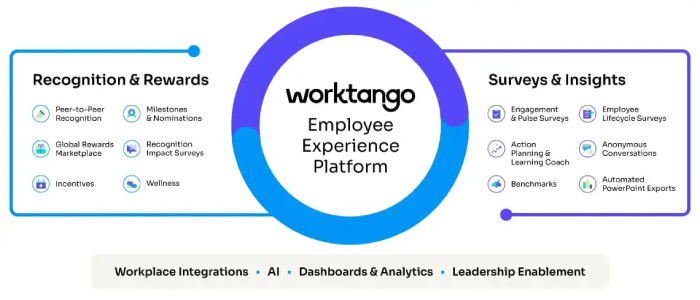
WorkTango combines employee surveys and insights with recognition, rewards, feedback, and employee experience capabilities.
Key Features
- Employee surveys
- Pulse surveys
- Employee feedback
- Engagement analytics
- Recognition
- Rewards
- eNPs
- AI-assisted analysis
- Mobile surveys
| Why consider it |
What to verify |
| WorkTango may be relevant for organizations that want employee listening and recognition within the same employee experience strategy. |
Check recognition and rewards pricing, survey functionality, analytics, AI capabilities, integrations, implementation requirements, and reward-related costs. |
Pros
-
Combines employee recognition, rewards, surveys, and engagement analytics.
-
Makes peer-to-peer recognition and employee appreciation easy.
-
Helps HR teams understand employee sentiment through surveys and dashboards.
-
Offers a variety of reward options, including gift cards and merchandise.
-
Supports action planning based on employee feedback.
-
Generally receives positive user feedback for ease of use and customer support.
Cons
-
Some users report limitations in custom reporting and data exports.
-
Reward points may expire, depending on the program rules.
-
Some rewards may require a substantial number of points to redeem.
-
Occasional slow loading or technical glitches are reported by users.
-
The range of features may create a learning curve for new users.
-
Complex, multi-country recognition programs may require additional setup and configuration.
Best for:Frontline and deskless employees
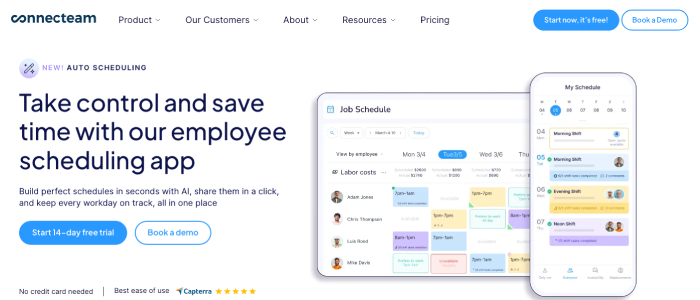
Connecteam is a workforce management platform designed particularly for frontline, field, mobile, and deskless employees. Its mobile-focused approach can be relevant for organizations that need to communicate with employees, provide training, support recognition, and collect feedback outside a traditional office environment.
Key Features
- Employee communication
- Mobile access
- Recognition
- Rewards
- Celebrations
- Training
- Workforce management
- Surveys
- Feedback
- Frontline workforce capabilities
| Why consider it |
What to verify |
| Frontline employees may have different engagement requirements from office-based employees. Mobile accessibility, communication, and workforce tools can therefore be important considerations. |
Check the exact engagement and HR capabilities included in the selected plan, user limits, mobile features, integrations, implementation requirements, and total cost. |
Pros
-
Mobile-friendly platform designed for frontline, deskless, and field employees.
-
Combines team communication, shift scheduling, and time tracking in one app.
-
Supports employee engagement through updates, surveys, and recognition features.
-
Offers task management, training, and digital forms.
-
Helps simplify workforce coordination and daily operations.
-
Generally receives positive user feedback for ease of use and scheduling.
Cons
-
Some advanced features are available only on higher-tier plans.
-
Pricing may become expensive as teams grow or require additional features.
-
Users report occasional app performance issues and technical glitches.
-
Notifications may feel excessive or require customization.
-
Some users report limitations in reporting, templates, and customization.
-
Initial setup and navigation can take time for administrators and new users.
Best for:Employee engagement, recognition, and rewards
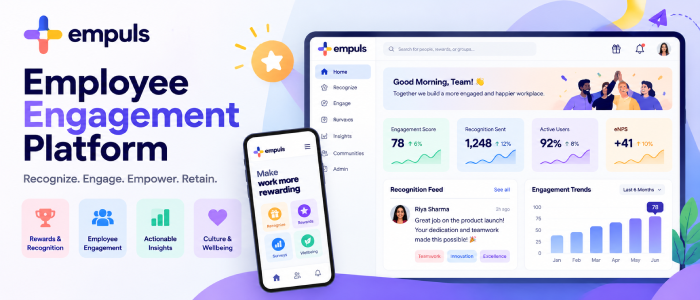
Empuls combines employee engagement with surveys, feedback, recognition, rewards, and employee communication. It may be particularly relevant for organizations where recognition and rewards are an important component of employee engagement.
Key Features
- Employee engagement surveys
- Pulse surveys
- Employee feedback
- Recognition
- Rewards
- eNPS
- Analytics
- Employee communication
| Why consider it |
What to verify |
| Empuls may be suitable for organizations that want employee feedback and recognition programs to operate within the same engagement strategy. |
Ask about current pricing, reward costs, analytics capabilities, integrations, implementation, employee eligibility, and the specific modules included. |
Pros
-
Combines employee recognition, rewards, surveys, and internal communication.
-
Supports peer-to-peer recognition and employee appreciation.
-
Offers a wide range of rewards, including gift cards, merchandise, and experiences.
-
Provides pulse surveys and feedback tools to measure employee sentiment.
-
Supports employee milestones, celebrations, and reward programs.
-
Offers integrations with HR systems and collaboration tools.
Cons
-
Reward options may vary depending on the employee’s country or region.
-
Reporting and analytics may not provide enough detail for some organizations.
-
Some users report occasional technical issues or slow loading.
-
Mobile app functionality and stability may need improvement.
-
Integration with certain HR systems may require additional configuration.
-
Pricing and reward-related costs can be difficult to compare without a customized quote.
Best for:Employee engagement, recognition, and rewards
Empuls combines employee engagement with surveys, feedback, recognition, rewards, and employee communication. It may be particularly relevant for organizations where recognition and rewards are an important component of employee engagement.
Key Features
- Employee surveys
- Pulse surveys
- Employee feedback
- Survey automation
- Analytics
- Reporting
- Integrations
- Feedback collection
| Why consider it |
What to verify |
| SurveySparrow may be useful when employee surveys and feedback collection are the main requirements. |
Check the employee-specific capabilities in the selected plan, survey limits, analytics, automation, integrations, data privacy, and support. |
Pros
-
Combines employee recognition, rewards, surveys, and internal communication.
-
Supports peer-to-peer recognition and employee appreciation.
-
Offers a wide range of rewards, including gift cards, merchandise, and experiences.
-
Provides pulse surveys and feedback tools to measure employee sentiment.
-
Supports employee milestones, celebrations, and reward programs.
-
Offers integrations with HR systems and collaboration tools.
Cons
-
Reward options may vary depending on the employee’s country or region.
-
Reporting and analytics may not provide enough detail for some organizations.
-
Some users report occasional technical issues or slow loading.
-
Mobile app functionality and stability may need improvement.
-
Integration with certain HR systems may require additional configuration.
-
Pricing and reward-related costs can be difficult to compare without a customized quote.
Best for:Pulse surveys and team feedback
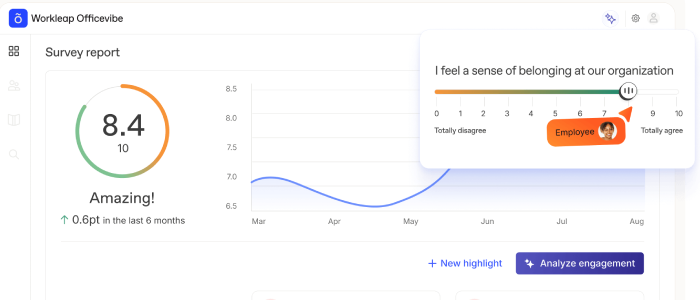
Workleap Officevibe focuses on employee feedback, pulse surveys, engagement reporting, and team insights. Workleap's current product information describes Officevibe as a tool for collecting and acting on employee feedback, with Pulse Surveys, anonymous feedback, team reports, and ongoing manager conversations. Workleap has also integrated Officevibe into its broader platform, with capabilities including weekly pulse surveys, manager action recommendations, Good Vibes peer recognition, and team feedback.
Key Features
- Pulse surveys
- Employee feedback
- Anonymous feedback
- Engagement reporting
- Team insights
- Recognition
- Action planning
- Analytics
| Why consider it |
What to verify |
| Officevibe may be relevant for organizations that want recurring employee feedback and team-level engagement information. |
Check the current Officevibe product packaging, pricing, AI capabilities, integrations, employee limits, reporting, and support included in the proposal. |
Pros
-
Offers short, recurring pulse surveys to collect employee feedback.
-
Supports anonymous feedback to help employees share workplace concerns.
-
Provides engagement metrics and reports to identify employee sentiment trends.
-
Features an easy-to-use interface for employees and managers.
-
Includes feedback and action-planning tools to help managers address concerns.
-
Supports peer recognition through its Good Vibes feature.
Cons
-
Repeated survey questions may lead to employee survey fatigue.
-
Custom reporting and data-export options may be limited for some users.
-
Some users report limited flexibility in customizing survey questions.
-
Employees in small teams may have concerns about the anonymity of their feedback.
-
One-on-one meeting templates and scheduling may feel cumbersome to some users.
-
Pricing may be challenging for smaller organizations, depending on the selected plan.
Employee Engagement Platforms by Use Case
Best for Enterprise Employee Experience
Organizations with complex employee experience and employee listening requirements may consider Qualtrics Employee Experience or Culture Amp.
These platforms provide broader capabilities around employee listening, engagement data, analytics, and action planning.
Best for Engagement and Performance
Organizations that want engagement connected with performance, goals, feedback, and development may consider Lattice or Leapsome.
Best for Continuous Feedback
Organizations moving away from occasional surveys toward continuous feedback may consider 15Five or Workleap Officevibe.
Best for Recognition and Rewards
Organizations that consider recognition and rewards a central part of their engagement strategy may investigate WorkTango or Empuls.
Best for Frontline Employees
Organizations with deskless, field, retail, hospitality, construction, or mobile employees may need strong mobile communication and workforce capabilities. Connecteam is particularly relevant to investigate for this type of workforce.
Best for Survey-Focused HR Teams
If the primary requirement is employee surveys, pulse feedback, reporting, and survey management, SurveySparrow may be worth considering.
Employee Engagement Software vs. Employee Engagement Tools
The terms employee engagement software and employee engagement tools are often used interchangeably, but they can describe different levels of functionality.
An employee engagement tool may focus on a specific requirement, such as employee surveys, pulse surveys, feedback, recognition, or rewards.
Employee engagement software may combine several capabilities in one platform, such as surveys, feedback, analytics, action planning, recognition, and employee experience management.
Some platforms also combine employee engagement with performance management, learning, workforce management, or broader people-management capabilities.
How to Choose the Best Employee Engagement Platform
There is no single employee engagement platform that will be right for every organization. Start by identifying the business and HR problem you want the software to address.
- Define Your Engagement Goals
Determine what you want the platform to accomplish.
Your objective might be to:
- Measure employee engagement
- Collect continuous feedback
- Improve manager effectiveness
- Strengthen recognition
- Understand employee sentiment
- Improve action planning
- Connect engagement with performance
- Monitor employee experience
- Consider Your Workforce
Consider:
- Number of employees
- Remote and hybrid employees
- Frontline employees
- Deskless workers
- Multiple locations
- Multiple countries
- Languages
- Manager structure
A platform that works well for a 200-person office-based organization may not be the right choice for a 10,000-person frontline workforce.
- Review Survey and Feedback Features
Check whether the platform supports:
- Annual engagement surveys
- Pulse surveys
- Targeted surveys
- Anonymous feedback
- Open-ended questions
- eNPS
- Custom questions
- Lifecycle surveys
- Automated survey schedules
- Examine Analytics and Reporting
A survey is only useful when HR and managers can understand the results.
Look for:
- Dashboards
- Trend analysis
- Team-level reporting
- Segmentation
- Benchmarking
- Sentiment analysis
- Engagement-driver analysis
- Data exports
- Check Action Planning
Ask what happens after employees provide feedback.
Can managers:
- Create action plans?
- Assign responsibilities?
- Track progress?
- Identify priority areas?
- Communicate actions to employees?
The ability to close the feedback loop can be more important than simply collecting survey responses.
- Review Recognition Capabilities
If recognition is important, determine whether recognition is:
- Included in the platform
- Available as an additional module
- Connected to rewards
- Available through mobile
- Integrated with collaboration tools
- Check Integrations
Consider whether the platform integrates with your existing:
- HRIS
- Payroll systems
- Microsoft Teams
- Slack
- Collaboration tools
- Identity systems
- Reporting platforms
- Review Privacy and Employee Anonymity
Employee feedback may contain sensitive information.
Ask vendors about:
- Data storage
- Data protection
- Employee anonymity
- Response thresholds
- Access controls
- Reporting permissions
- Data retention
- Applicable privacy requirements
- Understand the AI Features
Many employee engagement platforms now use AI for tasks such as summarizing comments, identifying themes, analyzing sentiment, or suggesting actions.
Instead of simply asking whether the platform has AI, ask:
- What does the AI actually do?
- Is it included in the selected plan?
- Does it analyze open-text feedback?
- Can it identify engagement themes?
- Does it recommend actions?
- How is employee data processed?
- Can administrators control AI features?
- Calculate the Total Cost
The subscription price may not represent the complete cost.
Consider:
- Subscription fees
- Additional modules
- Minimum annual commitments
- Implementation
- Integrations
- Support
- Training
- Rewards budgets
- Additional users
- Data migration
Benefits of Employee Engagement Software
Employee engagement software can help HR teams create a more structured employee listening and feedback process.
More Frequent Feedback
Pulse surveys and continuous feedback can help organizations understand changes in employee sentiment between larger surveys.
Better Visibility
Analytics can help HR teams identify trends across teams, departments, locations, or other workforce groups.
More Structured Action
Action-planning capabilities can help managers move from reviewing feedback toward identifying potential areas for improvement.
Consistent Recognition
Recognition features can help organizations make employee appreciation a more regular part of workplace culture.
Centralized Engagement Data
A dedicated platform can bring employee surveys, feedback, analytics, and engagement information together.
Support for Employee Experience
Broader employee experience platforms can connect engagement data with other employee lifecycle and people-management processes.
Final Thoughts
Choosing employee engagement software should start with your organization's requirements rather than with the number of features a vendor offers.
Enterprise organizations may prioritize employee listening and employee experience analytics. Performance-focused teams may want engagement connected with goals, feedback, and reviews. Recognition-focused organizations may prioritize rewards and recognition, while frontline businesses may need mobile communication and workforce capabilities.
Before choosing a platform, compare:
- Employee survey capabilities
- Feedback functionality
- Recognition and rewards
- Analytics
- Action planning
- Integrations
- Privacy and anonymity
- AI capabilities
- Mobile access
- Implementation
- Support
- Total cost
A useful employee engagement process can be summarized as:
Listen → Understand → Act → Communicate → Measure Again
The objective is not to collect the largest possible amount of employee feedback. The objective is to collect useful information, understand what employees are telling the organization, and take meaningful action.
Editorial Disclosure
This HRHelpBoard article is an informational comparison based on publicly available product and vendor information. HRHelpBoard has not independently tested or audited every platform listed and does not claim that one platform is universally better than another.
Product features, pricing, plans, integrations, availability, and terms can change. Readers should verify current information directly with the relevant vendor before making a purchasing decision.
Inclusion in this article does not constitute an endorsement, certification, guarantee, or representation of product performance by HRHelpBoard.
Any affiliate, sponsorship, advertising, or other commercial relationship associated with a vendor or link should be clearly disclosed where applicable.