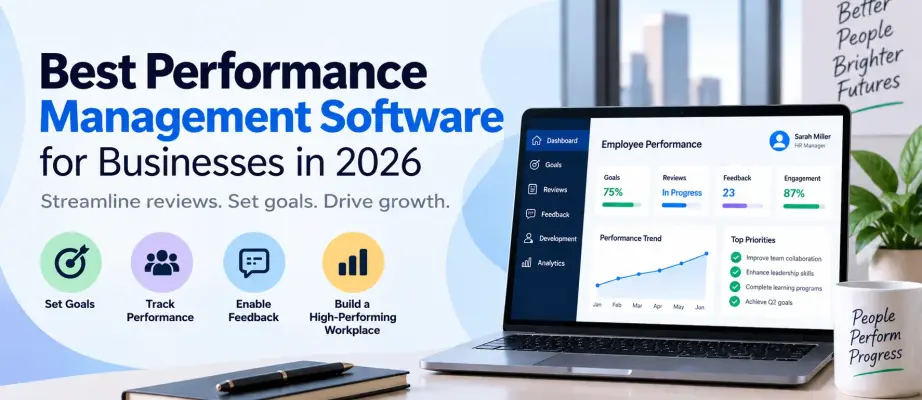
Best Performance Management Software for Businesses in 2026
Performance management software helps businesses manage employee goals, performance reviews, feedback, evaluations, development plans, and performance-related data through a centralized digital platform.
Instead of relying on spreadsheets, emails, paper forms, and separate systems, HR teams can use performance management software to create structured review cycles, track employee goals, provide continuous feedback, and support employee development.
In 2026, businesses have many options, ranging from dedicated performance management platforms to broader HR software with built-in performance management features. The right solution depends on company size, workforce requirements, performance process, budget, integrations, reporting needs, and scalability.
What Is Performance Management Software?
Performance management software is a digital HR solution that helps organizations plan, monitor, evaluate, and improve employee performance.
Common capabilities include:
- Employee goal setting
- Performance reviews
- Continuous feedback
- 360-degree feedback
- Self-assessments
- Performance ratings
- OKRs and KPIs
- Employee development plans
- Performance tracking
- Recognition
- Reporting and analytics
The software can help HR teams and managers manage performance throughout the year rather than relying only on an annual performance review.
Best Performance Management Software for Businesses in 2026
There is no single performance management software that is suitable for every business. The best option depends on the organization's workforce, performance management methodology, HR technology environment, and specific requirements.
The following software categories and platforms are commonly considered when businesses evaluate performance management solutions.
1. Lattice
Lattice is a people management platform that includes performance management capabilities.
Businesses can use Lattice for employee performance reviews, goal management, continuous feedback, engagement, and employee development.
Performance management capabilities may include:
- Performance reviews
- Goals and OKRs
- Continuous feedback
- 1:1 meetings
- Employee development
- Engagement
- Performance-related reporting
Lattice can be considered by organizations looking for a platform that connects performance management with broader people-management processes.
2. 15Five
15Five provides performance and people-management solutions designed to support employee engagement, manager effectiveness, feedback, and development.
Its performance-related capabilities can support structured reviews while encouraging more regular conversations between managers and employees.
Key areas include:
- Performance reviews
- Goals
- 1:1s
- Continuous feedback
- Engagement
- Manager development
- Employee development
It may be suitable for businesses that want performance management to be part of an ongoing employee-management process rather than an annual review alone.
3. Culture Amp
Culture Amp combines employee experience, engagement, performance, and development capabilities.
Its performance management functionality can help organizations establish structured reviews, goals, feedback, and development conversations.
Relevant capabilities include:
Performance reviews
- Goals
- Feedback
- Employee development
- Engagement surveys
- People analytics
Culture Amp may be considered by organizations looking to connect employee performance with engagement and employee experience data.
4. Betterworks
Betterworks focuses on continuous performance management and strategic goal alignment.
The platform supports organizations that use goals and ongoing performance conversations as part of their management approach.
Performance-related features include:
- Goal management
- OKRs
- Performance reviews
- Continuous feedback
- Coaching
- Employee development
- Performance insights
Businesses using OKRs or other structured goal frameworks may evaluate Betterworks when looking for software that connects organizational objectives with employee performance.
5. PerformYard
PerformYard provides performance management software focused on configurable performance processes.
Organizations can use performance management functionality for reviews, goals, feedback, and employee development.
Potential capabilities include:
- Performance reviews
- Goal setting
- 360-degree feedback
- Continuous feedback
- Competencies
- Performance reporting
- Development planning
Its configurable approach can be relevant for businesses that want their performance process to reflect their existing HR methodology.
6. Leapsome
Leapsome provides a people enablement platform covering performance, goals, engagement, learning, and employee development.
Its performance management capabilities can help businesses organize reviews, goals, feedback, and development activities.
Key areas include:
- Performance reviews
- Goals and OKRs
- 360-degree feedback
- Continuous feedback
- Employee development
- Engagement
- Learning
Leapsome can be considered by organizations looking for an integrated employee development and performance management platform.
7. Trakstar
Trakstar offers HR software with performance management capabilities.
Organizations can use performance-related functionality to structure employee evaluations, goals, feedback, and development processes.
Relevant capabilities may include:
- Employee evaluations
- Performance reviews
- Goal setting
- Feedback
- Employee development
- Performance tracking
- Reporting
Trakstar may be evaluated by businesses that want performance management combined with other HR processes.
8. BambooHR
BambooHR provides a broader human resources platform that includes performance management functionality.
Businesses using an HR management system may consider BambooHR when they want employee information and performance-related processes managed within a broader HR environment.
Performance-related capabilities can include:
- Performance reviews
- Goals
- Feedback
- Employee development
- Performance tracking
- HR reporting
This type of integrated HR platform can be useful when a business wants to avoid maintaining separate systems for core HR and performance processes.
9. SAP SuccessFactors
SAP SuccessFactors provides enterprise human capital management solutions with performance and goals functionality.
Large organizations can use enterprise HCM technology to connect employee performance with broader talent, workforce, and HR processes.
Relevant areas include:
- Performance management
- Goal management
- Continuous performance
- Employee development
- Talent management
- Workforce analytics
SAP SuccessFactors may be evaluated by larger organizations with complex HR technology and integration requirements.
10. Workday
Workday offers a broad HCM platform with capabilities covering employee performance, talent management, goals, feedback, and development.
Businesses with established enterprise HR environments may consider Workday when they want performance management connected with other workforce processes.
Relevant areas include:
- Performance management
- Goals
- Feedback
- Talent management
- Employee development
- Workforce analytics
Key Features of Performance Management Software
Goal Setting and Tracking
Goal-setting functionality helps employees and managers establish objectives and monitor progress. Depending on the platform, businesses may use SMART goals, KPIs, or OKRs.
Performance Reviews
Performance review tools allow HR teams to create review cycles, distribute assessments, collect responses, and document performance results.
Organizations can use annual, semi-annual, quarterly, or more frequent reviews depending on their process.
Continuous Feedback
Continuous feedback allows managers and employees to exchange performance-related feedback throughout the year instead of waiting for a formal annual review.
360-Degree Feedback
360-degree feedback collects input from multiple sources, such as managers, peers, colleagues, and direct reports. This can provide a broader view of employee performance.
Employee Development
Performance management software can connect performance discussions with employee development plans, skills, learning activities, and career goals.
Reporting and Analytics
Reporting features can help HR teams monitor review completion, goal progress, feedback activity, and other performance-related information.
Integrations
Businesses should check whether the software integrates with their existing HRIS, payroll, learning, collaboration, and other business systems.
AI-Assisted Features
Some performance management platforms now provide AI-assisted functionality. Depending on the provider, AI may help with tasks such as drafting feedback, summarizing information, or generating performance-related insights.
Organizations should review how employee information is processed and what privacy and security controls are available before using AI features.
Benefits of Performance Management Software
Performance management software can provide several operational benefits to businesses.
Centralized information: Goals, reviews, feedback, and development information can be maintained in one system.
Structured processes: Standardized workflows can help HR teams maintain consistent performance review processes.
Better goal tracking: Managers and employees can monitor progress toward objectives throughout the performance cycle.
Continuous conversations: Software can support regular check-ins and feedback rather than relying exclusively on annual reviews.
Employee development: Performance discussions can be connected with development plans and learning opportunities.
Reduced administration: Automated reminders, workflows, forms, and digital records can reduce manual HR work.
Reporting: HR teams can access performance-related reports and data to support workforce management.
How to Choose Performance Management Software
Businesses should evaluate software based on their actual performance management requirements.
Company Size
Small businesses may need simple performance reviews, goal setting, and feedback, while larger organizations may require advanced workflows, permissions, analytics, and integrations.
Performance Management Method
Determine whether your organization uses annual reviews, continuous performance management, OKRs, KPIs, competency assessments, 360-degree feedback, or another approach.
Ease of Use
Employees and managers need to use the platform regularly. A complicated system may make adoption more difficult.
Customization
Check whether review forms, rating scales, competencies, workflows, and performance cycles can be customized.
Reporting
Evaluate whether the platform provides the reports and dashboards required by HR managers and business leaders.
Security and Privacy
Performance records contain employee information. Review data security, access controls, privacy practices, and applicable compliance requirements.
Pricing
Performance management software pricing can vary according to employee count, features, modules, integrations, implementation, support, and contract terms.
Businesses should compare the total cost of ownership rather than looking only at the subscription price.
Performance Management Software for Small Businesses
Small businesses should generally look for software that is easy to implement, simple to administer, and scalable as the workforce grows.
Important features may include:
- Goal setting
- Performance reviews
- Employee feedback
- Basic reporting
- Development planning
- Simple administration
- Affordable pricing
- Integration with existing HR systems
A small organization may not need the complexity of a large enterprise HCM platform.
Performance Management Software for Growing Businesses
Growing companies should consider whether the software can support additional employees, departments, managers, performance cycles, and reporting requirements.
Scalability, customization, integrations, employee self-service, and role-based access can become increasingly important as the organization expands.
Performance Management Software vs Performance Management Tools
Performance management tools include methods such as SMART goals, KPIs, OKRs, 360-degree feedback, rating scales, self-assessments, and appraisal forms.
Performance management software provides the digital platform for implementing and managing these methods.
For example, a company may use OKRs as its performance management technique while using software to create goals, monitor progress, conduct reviews, and record feedback.
For a broader explanation of performance management methods, see our guide to Performance Management Tools: Types, Techniques & Examples.
Conclusion
Performance management software can help businesses organize employee goals, performance reviews, feedback, evaluations, development plans, and performance data in a centralized system.
The right solution depends on the organization's size, performance management methodology, workforce requirements, integrations, reporting needs, security requirements, scalability, and budget.
Before choosing a platform, HR teams should compare features, evaluate ease of use, check integrations and security controls, request demonstrations when appropriate, and verify current pricing and functionality directly with the software provider.