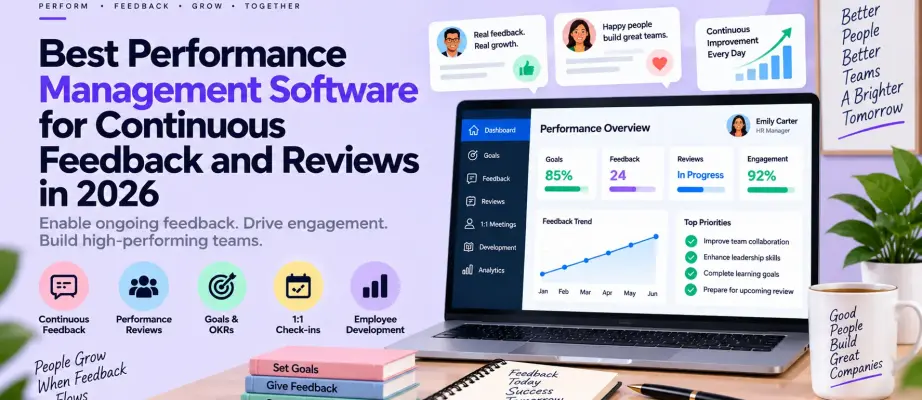
Best Performance Management Software for Continuous Feedback and Reviews in 2026
Continuous performance management has changed how organizations approach employee reviews. Instead of relying only on an annual appraisal, HR teams increasingly use regular check-ins, goal tracking, 1:1 conversations, peer feedback, 360-degree assessments and periodic reviews.
The right continuous performance management software can bring these activities into one system, helping managers record feedback, track goals and maintain a clearer performance history throughout the year.
Below are 10 performance management platforms to consider in 2026, with an emphasis on continuous feedback, performance reviews, goals, 1:1s and employee development.
What Is Continuous Performance Management Software?
Continuous performance management software helps organizations manage employee performance throughout the year rather than concentrating all evaluation activity into a single annual review.
A continuous process can include:
- Regular manager-employee check-ins
- 1:1 meetings
- Continuous feedback
- Goal and OKR tracking
- Peer feedback
- 360-degree feedback
- Self-assessments
- Performance reviews
- Employee development plans
- Recognition and coaching
- Performance analytics
PeopleGoal describes continuous performance management as an ongoing process incorporating goals, check-ins, 1:1s, peer feedback and reviews rather than relying primarily on annual appraisals.
This approach allows managers to capture performance information closer to when work happens, while employees can receive feedback and discuss development throughout the year.
10 Performance Management Software Tools for Continuous Feedback and Reviews
The following platforms offer different combinations of continuous feedback, performance reviews, goals, 1:1s, 360-degree feedback and employee development.
1. PeopleGoal
Best suited for: Organizations looking for configurable continuous performance management workflows
PeopleGoal provides a performance management platform built around ongoing employee performance conversations. Its functionality includes OKRs and SMART goals, check-ins, 1:1 meetings, peer feedback, 360-degree reviews and performance reviews.
Its performance review functionality can support monthly, quarterly or biannual review processes, allowing organizations to choose a cadence that fits their management model.
Key capabilities include:
- SMART goals and OKRs
- Weekly task tracking
- Check-ins and 1:1s
- Peer feedback
- 360-degree reviews
- Performance reviews
- Recognition
- Custom workflows
- Reporting and analytics
PeopleGoal also supports automated workflows for launching reviews and check-ins according to an organization's preferred schedule.
2. Synergita
Best suited for: Organizations looking for continuous feedback, periodic reviews and 360-degree appraisal capabilities
Synergita combines performance management with continuous feedback and employee development features.
Its performance management functionality supports periodic reviews, goal management, 360-degree appraisal, traditional performance appraisal, continuous feedback, performance improvement plans and individual development plans.
Key capabilities include:
- Continuous employee feedback
- Weekly, monthly or quarterly reviews
- Goal management
- 360-degree feedback
- Performance appraisals
- Performance improvement plans
- Individual development plans
- Employee development
- Performance analytics
- Dashboards and reporting
Synergita also provides feedback pages where managers, peers and internal customers can provide feedback or comments about an employee.
For HR teams that want performance reviews to connect with development and ongoing feedback, this makes Synergita a relevant option.
3. Quantum Workplace
Best suited for: Organizations combining performance reviews, feedback, goals and 1:1 conversations
Quantum Workplace brings several performance management activities together in one platform, including performance goals, feedback, performance reviews and 1:1s.
Its feedback functionality supports 360-degree, peer and upward feedback, while automated cycles can help HR teams schedule feedback activities around specific dates or employee milestones.
Key features include:
- Performance goals
- Goal alignment
- 360-degree feedback
- Peer feedback
- Upward feedback
- Performance reviews
- 1:1 meetings
- Manager coaching
- Feedback templates
- Performance analytics
- AI-assisted feedback and review workflows
The platform also allows performance information such as goals and feedback to be incorporated into review processes, providing additional context for performance conversations.
4. Teamflect
Best suited for: Organizations using Microsoft Teams for employee collaboration
Teamflect focuses on bringing performance management into Microsoft Teams. Its platform includes performance reviews, goals and OKRs, 360-degree feedback, recognition and 1:1 meetings.
Its 360-degree feedback functionality allows organizations to collect feedback from managers, peers, direct reports and external participants.
Key capabilities include:
- Performance reviews
- Goals and OKRs
- 360-degree feedback
- Continuous feedback
- 1:1 meetings
- Employee recognition
- Engagement surveys
- Talent management
- Microsoft Teams integration
For companies that already rely heavily on Microsoft Teams, having performance conversations and review workflows within an existing collaboration environment can reduce the need for employees to switch between separate applications.
5. Primalogik
Best suited for: Organizations emphasizing 360-degree feedback and structured performance assessments
Primalogik offers a performance management suite that includes 360-degree feedback, performance reviews, goals and OKRs, and instant feedback.
Its 360-degree feedback system collects input from different groups, including managers, peers and direct reports.
Key features include:
- 360-degree feedback
- Performance reviews
- Self-assessments
- Manager assessments
- Goals and OKRs
- Instant feedback
- Rating scales
- Anonymous feedback
- Automated reminders
- Participation tracking
- Performance analytics
Primalogik also supports configurable review workflows, including different sequences for self-reviews, manager reviews and 360-degree assessments.
This makes it particularly relevant for organizations that want a structured multi-rater feedback process rather than relying exclusively on manager evaluations.
6. Small Improvements
Best suited for: Growing organizations looking for an accessible performance review and feedback platform
Small Improvements combines performance reviews with objectives, 1:1 meetings, 360-degree feedback, praise and pulse surveys. Its platform is positioned for growing teams and is designed to support ongoing performance activities throughout the year.
Key capabilities include:
- Performance reviews
- Objectives and goals
- 1:1 meetings
- 360-degree feedback
- Continuous feedback
- Peer recognition
- Pulse surveys
- Performance analytics
- Slack integration
- HRIS integrations
The platform allows organizations to customize review questions, participants and review cadence. Feedback, objectives and 1:1 notes can also be accessed as context during reviews.
Small Improvements has also introduced AI Coach functionality designed to help employees and managers create more meaningful review content using information such as previous feedback, objectives, 1:1 notes and company career frameworks.
7. Peoplebox
Best suited for: Organizations connecting performance reviews with OKRs, 1:1s and calibration
Peoplebox combines performance reviews, goals, calibration, compensation workflows, 1:1s and continuous feedback.
Its performance management platform supports different review frameworks, including goals, competencies, values or combinations of these approaches. It also supports self, peer, manager and 360-degree feedback.
Key capabilities include:
- Performance reviews
- OKRs
- Goal hierarchies
- 360-degree feedback
- Self-assessments
- Peer feedback
- Manager feedback
- Calibration
- 9-box grids
- 1:1 meetings
- Continuous feedback
- Career development
Peoplebox also supports integrations with workplace tools, allowing goals and feedback to connect with workflows in tools such as Jira, Asana, Slack and Microsoft Teams.
For organizations where performance reviews need to connect closely with goal management and calibration, Peoplebox can be considered as part of the evaluation process.
8. WorkTango
Best suited for: Organizations combining continuous performance conversations with employee experience programs
WorkTango approaches performance management through continuous employee success practices that combine goals, feedback, 1:1 conversations and performance check-ins.
Its approach includes frequent manager-employee conversations, ongoing feedback and periodic performance check-ins rather than treating performance management as a once-a-year process.
Key capabilities include:
- Continuous feedback
- Goals and goal tracking
- 1:1 meetings
- Performance check-ins
- Performance reviews
- Recognition and rewards
- Talent reviews
- Employee surveys
- Employee insights
- Development conversations
WorkTango describes a continuous model in which regular 1:1 conversations and feedback provide information that can feed into quarterly performance check-ins and broader talent reviews.
This model can be useful for organizations that want performance management connected with employee engagement and recognition activities.
9. Reflektive
Best suited for: Organizations emphasizing real-time feedback, goals and regular performance conversations
Reflektive's performance suite focuses on ongoing performance conversations rather than relying only on traditional annual reviews.
Its platform includes goals, 1:1 conversations, reviews and check-ins, and continuous feedback.
Key features include:
- Real-time feedback
- Goal management
- 1:1 conversations
- Performance reviews
- Performance check-ins
- Employee recognition
- Engagement surveys
- People analytics
- HRIS integrations
Reflektive describes its feedback functionality as supporting timely, structured feedback that employees and teams can use for development.
The platform can therefore be considered by organizations looking for a performance process that combines goal tracking with frequent feedback and development conversations.
10. Eletive
Best suited for: Organizations connecting performance management with goals, 1:1s and employee insights
Eletive provides performance management functionality covering goals, performance assessments, 1:1s and 360-degree feedback.
Its performance assessment functionality supports self-assessments and manager evaluations, helping organizations create structured performance conversations.
Key capabilities include:
- Performance assessments
- Self-assessments
- Manager evaluations
- SMART goals
- OKRs
- 1:1 meetings
- 360-degree feedback
- Action plans
- Progress tracking
- Performance notifications
Eletive also provides organizational templates for 1:1 conversations and performance processes, allowing HR teams to establish a more consistent approach across departments.
Key Features to Look for in Continuous Performance Management Software
Choosing a platform requires more than checking whether it includes performance reviews. The software should support the complete performance cycle.
- Continuous Feedback
The platform should make it easy for managers, employees and peers to give feedback throughout the year.
Useful functionality can include:
- On-demand feedback
- Peer feedback
- Manager feedback
- Upward feedback
- Feedback requests
- Feedback templates
- Anonymous feedback where appropriate
- Feedback history
Continuous feedback helps create a record of performance discussions instead of relying exclusively on information collected shortly before an annual review.
- Regular Check-Ins and 1:1 Meetings
Regular 1:1 conversations can provide a structured place to discuss:
- Current priorities
- Progress toward goals
- Challenges
- Development needs
- Feedback
- Recognition
- Career objectives
Some platforms connect 1:1 notes directly with goals and performance reviews, making it easier to carry relevant information forward.
- Performance Reviews
A modern performance management system should support configurable review cycles.
Look for:
- Custom review forms
- Self-assessments
- Manager assessments
- Peer reviews
- Review workflows
- Automated reminders
- Review approvals
- Different review schedules
- Historical performance records
Organizations may use quarterly, biannual or annual formal reviews while maintaining continuous conversations between those review periods.
- Goals and OKRs
Continuous performance management works more effectively when employee performance conversations are connected to measurable objectives.
Look for support for:
- SMART goals
- OKRs
- Individual goals
- Team goals
- Company goals
- Goal cascading
- Progress tracking
- Goal status
- Goal alignment
PeopleGoal, Quantum Workplace, Peoplebox and Eletive, for example, all document goal or OKR functionality within their performance platforms.
- 360-Degree Feedback
360-degree feedback can bring multiple perspectives into the performance process.
Depending on the software, feedback may come from:
- Managers
- Peers
- Direct reports
- Project colleagues
- Employees themselves
- External participants
Primalogik, Teamflect, Synergita, PeopleGoal and Quantum Workplace all provide functionality for multi-source feedback.
- Performance Analytics
Analytics can help HR teams monitor:
- Review completion
- Goal progress
- Feedback participation
- Performance trends
- Development needs
- Team-level patterns
- Review outcomes
Good reporting should make performance information easier to interpret without requiring HR teams to manually consolidate spreadsheets.
- Employee Development
Performance reviews should ideally lead to action.
Look for features supporting:
- Individual development plans
- Coaching
- Career goals
- Skill development
- Development conversations
- Performance improvement plans
- Learning recommendations
Synergita, for example, includes individual development plans and performance improvement plans within its performance management functionality.
Benefits of Continuous Performance Management Software
A continuous performance management platform can help organizations create a more structured approach to employee performance.
More frequent feedback
Managers can provide feedback closer to the event instead of waiting for a formal review cycle.
Better performance documentation
Goals, feedback, check-ins and review information can be stored in one system.
Greater visibility
HR and managers can access performance information throughout the year instead of collecting it only during review periods.
More consistent processes
Templates and automated workflows can help standardize performance activities across teams.
Stronger development conversations
Regular discussions can connect performance observations with employee development and career goals.
Reduced administrative work
Automated reminders, review cycles and reporting can reduce some manual HR administration.
How to Choose the Right Continuous Performance Management Software
Before selecting a platform, HR teams should evaluate their existing performance management process.
Consider your review frequency
Determine whether you need monthly, quarterly, biannual or annual formal reviews alongside continuous feedback.
Evaluate feedback requirements
Decide whether your organization needs manager feedback, peer feedback, upward feedback, 360-degree reviews or all of these.
Review goal-setting capabilities
Check whether the software supports your existing SMART goals, KPIs, OKRs or other goal-setting framework.
Consider manager adoption
A complicated platform may make it harder for managers to maintain regular check-ins. Look for workflows that fit naturally into managers' existing routines.
Check customization
Review whether you can customize:
- Review questions
- Rating scales
- Feedback forms
- Workflows
- Goal structures
- Review schedules
- Permissions
Examine integrations
Check compatibility with your HRIS, collaboration tools, identity provider and other systems already used by your organization.
Review reporting and analytics
Make sure HR can obtain the reports needed for performance reviews, talent planning and workforce analysis.
Consider security and privacy
Performance data can contain sensitive employee information. Review access controls, authentication, data protection and administrative permissions before implementation.
Compare total cost
Do not compare software only by the advertised subscription price. Consider implementation, employee count, modules, integrations, support and any additional services.
How to Implement Continuous Performance Management
Technology alone does not create a continuous feedback culture. HR teams also need a clear process.
A practical implementation can follow these steps:
- Define the performance framework
Decide how goals, competencies, feedback and reviews will work together.
- Establish the feedback cadence
Determine when managers should conduct 1:1s, check-ins and formal reviews.
- Train managers
Managers need guidance on giving specific, constructive and actionable feedback.
- Configure the software
Create the required review templates, workflows, goals and permissions.
- Start with a pilot
Test the process with a department or smaller group before rolling it out across the organization.
- Monitor participation
Track review completion, feedback activity and goal progress.
- Improve the process
Use employee and manager feedback to adjust templates, schedules and workflows.
Conclusion
Continuous performance management software can help organizations move from isolated annual evaluations toward an ongoing process involving goals, feedback, check-ins, development and formal reviews.
The 10 platforms covered in this article—PeopleGoal, Synergita, Quantum Workplace, Teamflect, Primalogik, Small Improvements, Peoplebox, WorkTango, Reflektive and Eletive—take different approaches to continuous performance management.
The right choice depends on your organization's review cadence, feedback model, goal-setting framework, workforce size, integrations, reporting requirements and manager adoption needs. Before purchasing, HR teams should compare current features, pricing, implementation requirements and data/security policies directly with the vendors.
For organizations researching performance management technology more broadly, it is also useful to compare software based on the specific performance process they want to build rather than selecting a platform solely by the number of features it offers.